
Block Fundamentals
Overview
Last updated:
This page covers the essential skills for working with blocks in the UW Theme and WordPress, including how to add, organize, style, and hide blocks.
For a deeper dive into block concepts and editor behavior, visit the Working with blocks WordPress guide.
Before you start
This guide assumes basic familiarity with the WordPress block editor. For an overview of the editor interface, review Building a Page before continuing.
What are blocks
Like LEGO bricks, blocks are the basic building pieces of every page. Each piece of content you add in the editor is a block, including text, lists, images, buttons, links, and layout containers.
View the list of available blocks in UW Theme.
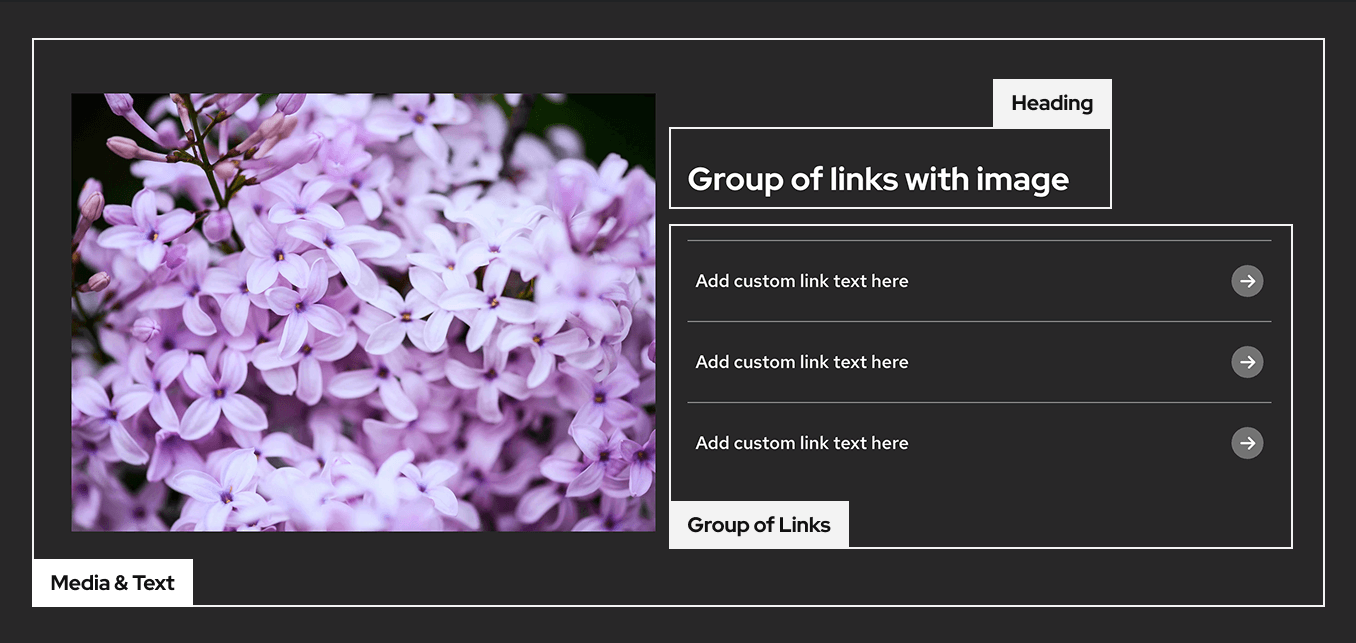
Tip: Use patterns to build layouts faster
Patterns are combinations of blocks that are already assembled for you. They help you create layouts quickly and follow UW–Madison branding and accessibility best practices.
Add blocks
You can add blocks in a few common ways:
- Use the Block Inserter (plus icon) in the top toolbar of the block editor
- Type a forward slash (
/) in the editor to search for a block - Click an Add block (plus icon) button that appears in the editor
View examples and learn more in the WordPress guide on Adding a new block.
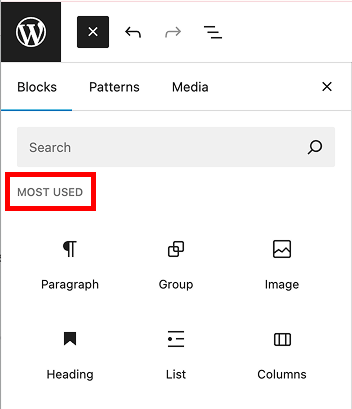
Tip: Show most-used blocks
You can set your preferences to show a list of your
most-used blocks at the top of the Block Inserter, which can speed up common workflows. Learn how set your editor preferences to enable this feature.
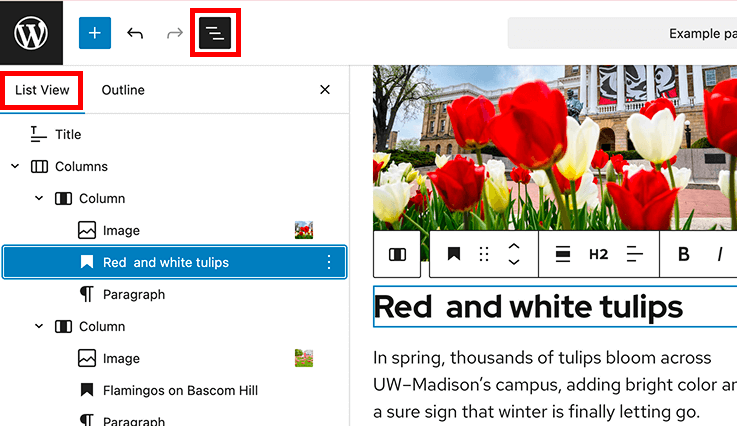
Manage blocks in List View
List View shows every block on your page in a structured list. It helps you select and manage blocks, especially in nested layouts or complex pages with layered content.
You can access List View from the top toolbar of the editor. Use it to select blocks in nested layouts, reorder blocks, and understand how your content is organized on the page.
Learn more in WordPress List View documentation.
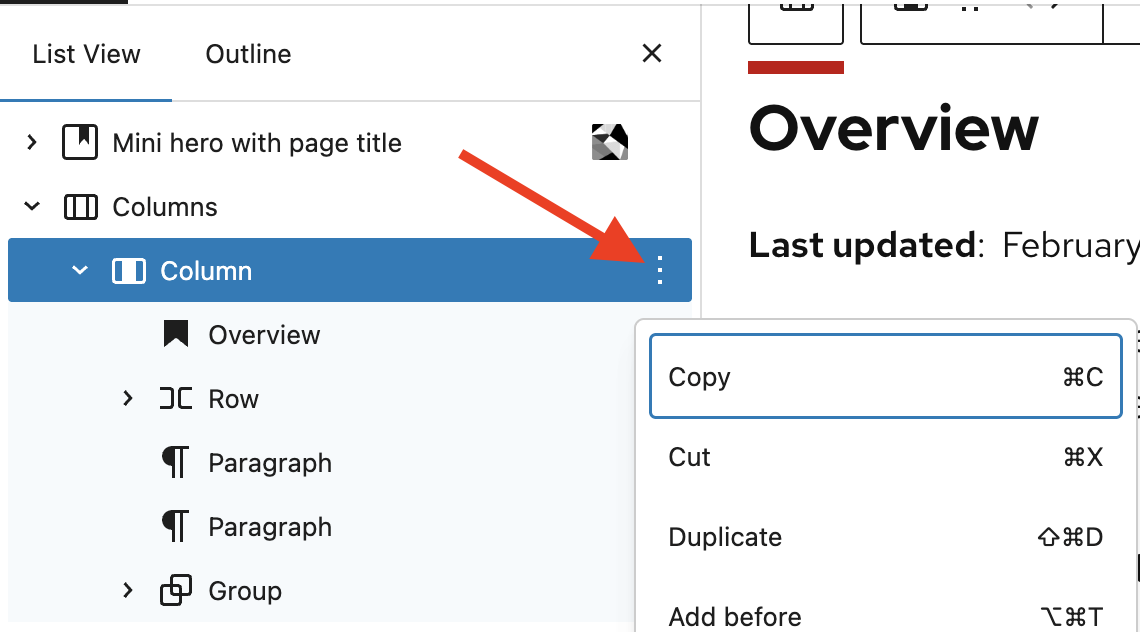
More options menu
You can also make changes to individual blocks using the More options (three-dot menu) in List View. This menu will display a dropdown selection of actions you can take for blocks like copy, cut, duplicate, remove, and more.
Block toolbar
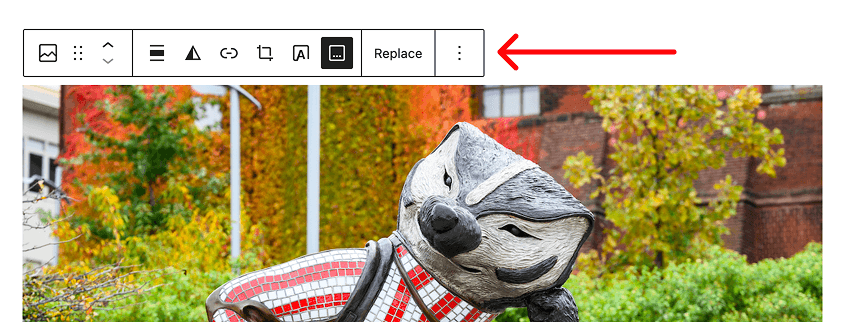
When you select a block, the block toolbar appears above it. The toolbar includes quick actions such as alignment, formatting, move controls, transform options, and more options. Available actions vary by block type.
Key features
The highlighted controls show a few key features of the block toolbar you may use often:
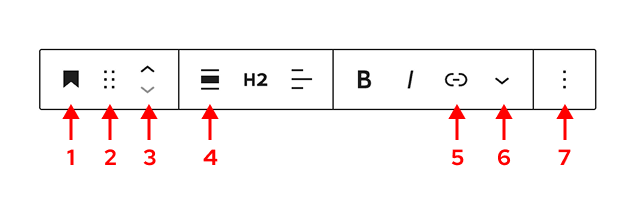
- Indicates the selected block type and allows you to transform it into a similar block.
- Drag/drop handle (six dots)
- Move block up or down
- Align options to manage content width or image alignment
- Link text options
- Additional text settings and options
- More options (three-dot menu) opens additional actions
View examples and detailed explanations in the WordPress Block toolbar documentation.
How to move blocks
Use the drag handle or the move up and down controls to reposition a block on the page. You can also drag blocks directly in List View, which is especially helpful for grouped or nested content.
For step-by-step guidance, visit the WordPress guide on Moving blocks.
How to style and customize blocks
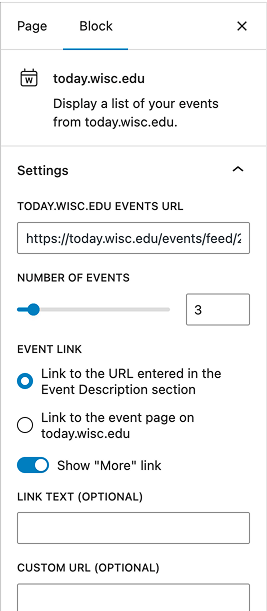
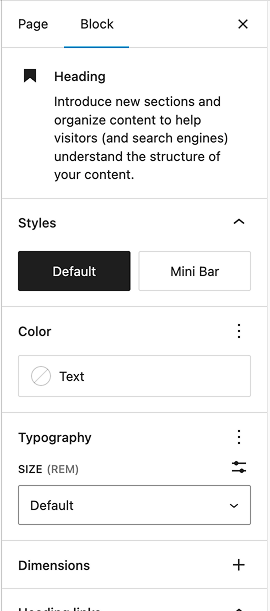
When a block is selected, open the Settings sidebar in the top toolbar of the block editor to view style and layout settings.
These settings vary by block but often include the following options:
- Color
- Typography
- Dimensions (margin, padding, block spacing)
- Borders and shadow
Settings also includes block-specific options like selecting the number of columns to use in the Columns block.
For guidance on making accessible, consistent design choices, visit Design best practices.
Can’t find a setting?
Some block settings may be unavailable in the UW Theme. This usually means the option has been intentionally limited to support accessibility, branding, or consistency across UW sites—or it’s currently under review.
If you think a setting is missing in error, contact the UW Theme team and let us know what you were trying to do.
How to organize blocks
As your pages grow and become more complex, organizing and structuring blocks helps keep your content easier to edit, update, and maintain over time.
Group blocks together
You can group blocks together to create a custom section. Grouping lets you treat multiple blocks as a single unit, making it easier to move, style, and manage related content. Group blocks by selecting Group from the More options (three-dot menu) in the block toolbar or List View.
Learn more about the Group block.
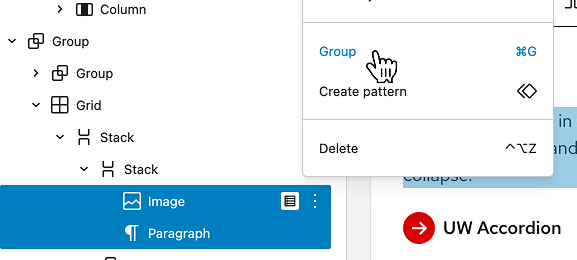
Rename blocks
As pages grow, naming sections can make them easier to manage and navigate. You can rename Group blocks and other blocks to describe the purpose of a section, such as “Intro,” “About,” or “Related links.”
Rename blocks by selecting Rename under More options (three-dot menu) in the block toolbar or List View.
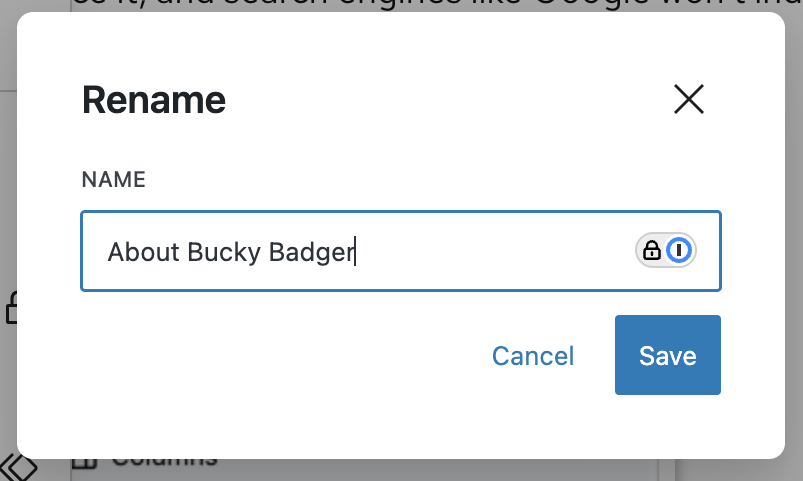
Change block and content width
Content width controls how wide a block appears on the page. In the UW Theme, width is applied per block rather than for the entire page. This allows different sections of a page to use different widths.
You can change the content width of a block using the Align option in the block toolbar. The active width option is shown with a white icon on a black background shown below:
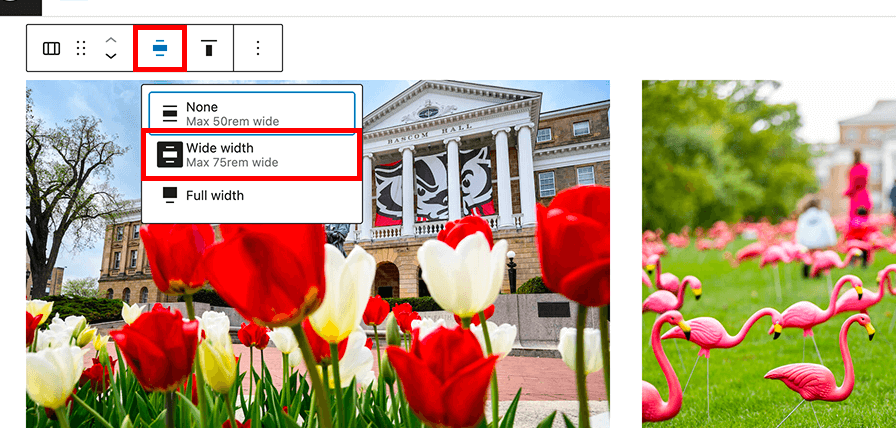
Block width options
Not all blocks support width options. The ones that do generally support three different width options that control how wide the content appears on the page:
- None (default): Standard content width. Best choice for most text content.
- Wide width: Expands the block wider than the default, leaves margins on either side.
- Full width: Expands the block to the edges of the screen.
Note: Layout examples are responsive and may appear differently depending on screen size.

None

Wide width

Full width
How to manage width of nested layouts
For blocks that contain other blocks, such as Group, Columns, or Grid, content width settings are applied to the parent block, not the individual inner blocks.
Below shows the parent Columns block selected, which contains two inner Column blocks.
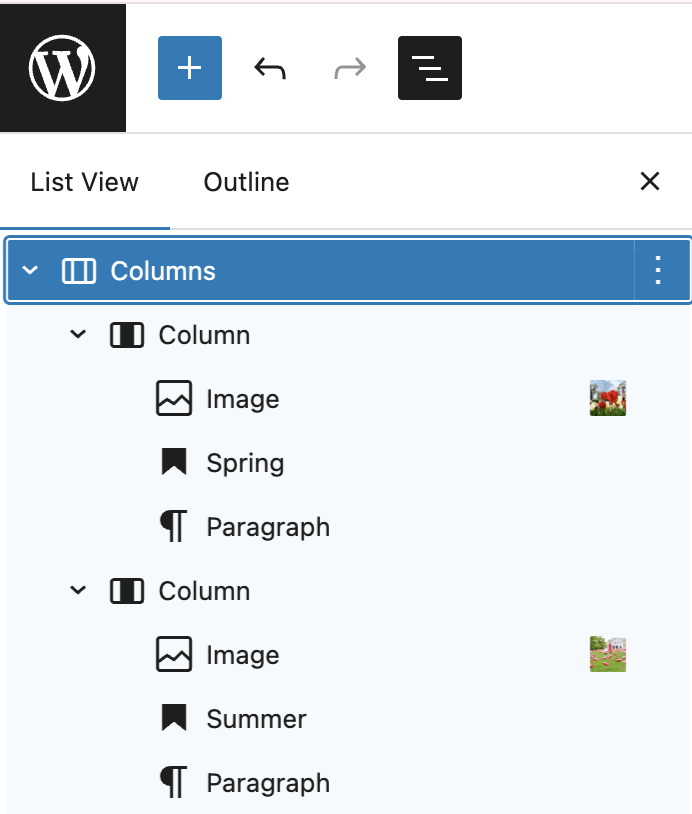
If you are unsure which block controls the width of a section, use List View to select the parent block before adjusting the width.
Toggle off inner content width
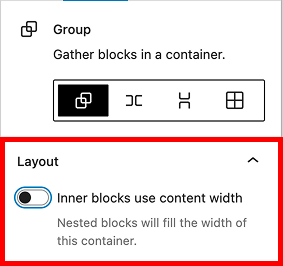
In some blocks such as Group, Columns, and Grid, you can toggle off the Inner blocks use content width in the Block Settings sidebar so that nested blocks fill the width of its parent container.
Learn more about content width in the WordPress Layout Settings overview guide.
Create accessible content widths
Default width (“None“) results in a narrower content area, which helps limit line length for text-heavy content like lists, paragraphs, and headings.
Accessibility guidance recommends a line length of 80 characters or fewer. Shorter line lengths make text easier to read and scan for people with visual and cognitive disabilities.
For examples of best practices, visit the Patterns Showcase to learn how the UW Theme uses content width for different types of layouts.
Hide blocks and page content
You may want to keep content in the editor without showing it on the published page. For example, when working on draft content, layouts, or hiding seasonal content.
Content is hidden using WordPress’s built-in Hide block feature. In the UW Theme, this option is intentionally limited to the Group and Cover blocks to ensure hidden content behaves predictably and is easy to manage.
Hidden blocks:
- Are not visible in the block editor until unhidden
- Do not appear on the published page
- Are not read by screen readers
- Are not indexed by search engines
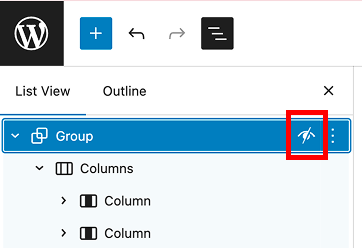
- Display a slashed eye icon in List View
Hide content using a Group or Cover block
When you hide a Group or Cover block, all content inside it is hidden as well. To hide multiple items, group them together first and hide the Group.
- In List View, select the Group or Cover block.
- Open the More options (three-dot menu) and select Hide.
- The block appears with a slashed eye icon in List View, indicating it’s hidden.
For a video walkthrough and more details, see the WordPress documentation on hiding blocks.